
Exploring the Writing for Wellbeing Landscape:
A Reflective Review of the Evidence
Kate McBarron
Writing for Wellbeing Practitioner
Abstract
When Kate McBarron came across the concept of writing for wellbeing in 2012, the discovery felt like stepping into a new world—into a 'rich landscape'. Here, via an exploration of the field with the help of artificial intelligence, she has brought this landscape to life. The aim was to consolidate her knowledge as well as to illustrate the breadth and depth of the writing for wellbeing field. Embedded within her review are a host of natural-world metaphors, which provide a springboard for showcasing examples of the evidence that has shaped her view of the field. Evidence is explored across five key areas: physical health, mental health, self-development, community, and work. Areas for future research are also highlighted.
Keywords: writing for wellbeing, expressive writing, poetry therapy, journal therapy, reflective practice, evidence
APA citation: McBarron, K. (2026). Exploring the writing for wellbeing landscape: A reflective review of the evidence. LIRIC Journal, 5(1), 1–26.
Introduction
In 2012, I became captivated by the rich field of writing for wellbeing. At that time, I had been a writer in various capacities, personally and professionally, for many years. I also had a strong drive, for health reasons, to improve my wellbeing. As I learned more about writing for wellbeing, I became fascinated by its power, versatility, and potential to enrich people’s lives. I began to think of this field as a ‘rich landscape’.
Delving into writing for wellbeing’s evidence base over the years, I found it stretched in many directions, and it felt fragmented. So, in 2024, with more than a decade of experience as a writing for wellbeing
practitioner under my belt, I began a reflective review of my journey so far through the evidence. The aim was to consolidate my knowledge and to
illustrate the breadth and depth of the writing for wellbeing field.
To start with, I went back through my reflective journals, my Creative Writing for Therapeutic Purposes MSc course materials, my old Twitter feeds, research files, and projects files. I also revisited the entries in my Writing for Wellbeing Research Database, which at that point I had been compiling for over a decade. My goal was to gather the pieces of evidence
that had most influenced me over the years, whether for personal or professional reasons.
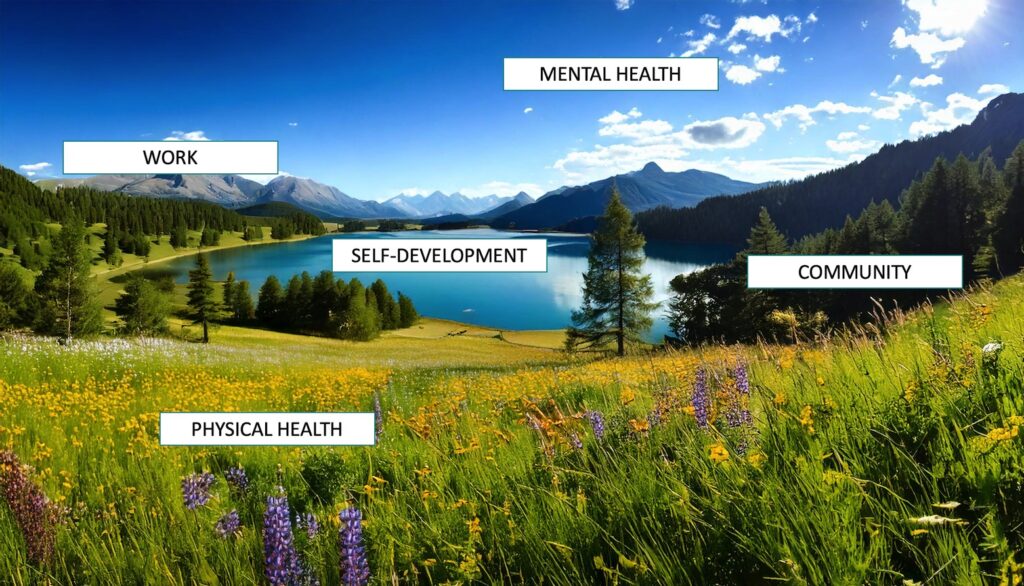
Once this evidence was gathered, I collated it under five wellbeing headings: physical health, mental health, self-development, community, and work. I mapped my findings against natural-world metaphors. Then, to bring my landscape to life, I chose Adobe’s Firefly generative artificial intelligence tool—which was praised at the time for its ability to generate
photorealistic imagery (Griffiths, 2025). Using prompts featuring my chosen metaphors, I instructed Firefly to create a landscape. From the resulting selection, I chose the one that aligned, intuitively, with my own vision of wellbeing. Finally, I edited the image in line with my writing for wellbeing journey and overlaid my five wellbeing headings.
In this article, I will share the results of this project, including the evidence that I gathered, the metaphors I chose, and the landscape I created.
Defining Writing for Wellbeing
For the purposes of this article, the term writing for wellbeing refers to the intentional use of the written word to support wellbeing aims, such as health, good functioning, and life satisfaction. The written word, in this context, can be either a tool to facilitate wellbeing in some way or the product of an intervention. I am not including writing that is done for another purpose where wellbeing outcomes are a by-product rather than the aim.
Examining the Evidence
There is a wealth of anecdotal evidence available on the wellbeing benefits of writing. In this article, I focus on evidence that is grounded in science, rigorous examination, and/or extensive experience. This includes empirical studies, descriptive and exploratory studies, project evaluations, case studies, and the experience of expert practitioners as documented in handbooks and textbooks.
We are often warned about relying on individual experience when making decisions for wider populations. However, borrowing a concept from Michael Wood (2024), while anecdotes or case studies might not tell us what is probable, they do point to what is possible. For the writing for wellbeing practitioner who seeks an innovative solution to a problem or the researcher who wishes to advance the field, these individual cases can provide useful starting points.
Where It All Began
I was thirty-two years old when I happened across the field of writing for wellbeing. I had been drawn to writing and to the concept of wellbeing from an early age. However, I had not realised that the two went so neatly hand-in-hand until I discovered James Pennebaker’s expressive writing research.
It felt as though I had opened a door to an exciting new world. The image in Figure 1 is an interpretation of the landscape I had entered. In reality, you cannot separate physical health from mental health, from social support, from work and purpose or self-development. The landscape metaphor itself demonstrates just how interlinked everything really is. The groupings here are purely to help organise the evidence.
In the sections that follow, I will go through each area—physical health, mental health, self-development, community, and work—highlighting the evidence that has shaped my view of the field along the way.
Physical Health
We start in the wildflower meadow. Here, the earth is ‘body’. For the meadow to reach its full potential, the soil must be healthy. Balanced weather conditions will provide the right levels of sunlight and rain. When these factors come together, the meadow is lush and blooming.
My writing for wellbeing journey began with the expressive writing research of Pennebaker and his colleagues. Learning that writing could improve not only mental health but also physical health was, for me, an incredible revelation. Suddenly, I became aware that writing—this activity I had been drawn to since childhood—was much more powerful than I realised.
The expressive writing research appealed to both my creative, intuitive mind and my scientific mind (I come from a family of NHS doctors and share similar ways of thinking). Plus, it tapped into my own fascination with the link between mind and body—a topic I went on to explore in my MSc dissertation. Taking all of this into account, physical health was a natural starting point for my journey through the evidence.
Expressive Writing Research
The first expressive writing study, published by Pennebaker & Beall (1986), demonstrates that expressive writing could improve the physical health of non-clinical participants. Later studies would go on to show that expressive writing could, among other things, enhance immune function, reduce symptoms for various clinical groups, and speed up wound healing (Pennebaker & Smyth, 2016).
A meta-analysis by Smyth (1998, p. 174) found that in non-clinical participants, expressive writing ‘enhanced’ health ‘across a number of areas, including reported physical health, physiological functioning, and general functioning’. This analysis sparked further research. Then, from 2003 to 2006 there was a flurry of activity among researchers wanting to analyse the evidence to date. Some of them found that expressive writing had a positive effect on health (Frisina, Borod, & Lepore, 2004; Frattaroli, 2006). Some of them revealed mixed results or found no clear benefits (Meads, Lyons, & Carroll, 2003; Meads & Nouwen, 2005; Mogk, Otte, Reinhold-Hurley, & Kröner-Herwig, 2006; Harris, 2006).
A 2016 systematic review looks specifically at expressive writing for people with long-term conditions. It pulled together findings from studies that focused on a host of chronic conditions, including HIV, various types of cancers, Type 2 diabetes mellitus, cystic fibrosis, dementia, cardiovascular disease, chronic pain, and more. The review itself found ‘very little’ evidence of benefit in some cases, ‘no evidence’ in others, and in others still the data were either ‘unavailable’, ‘sparse’ or ‘inconsistent’ (Nyssen et al., 2016, p. viii).
In 2018 came a literature review of the ‘best possible self’ intervention—which offers a positive twist on the original expressive writing approach. This highlights a number of studies where participants experienced improvements in their health. Overall, the researchers conclude that ‘there is much to recommend the BPS [best possible self] intervention’ (Loveday, Lovell, & Jones, 2018).
Gratitude Writing Research
In a white paper on the science of gratitude, Summer Allen (2018) dedicates a section to the topic of physical health and highlights a number of studies that feature writing. These cover a variety of participant groups including college students, middle school students, people with neuromuscular disease, and heart failure patients. Some of the experiments showed improvement in physical health or sleep quality (Emmons & McCullough, 2003; Jackowska, Brown, Ronaldson, & Steptoe, 2016; Redwine et al., 2016) while others found no improvements (Froh, Sefick, & Emmons, 2008).
Handbooks and Textbooks by Experts
I have focused so far on research papers published in academic journals. However, my own journey as a practitioner has been inspired by evidence from a variety of sources, including examples of practice found in handbooks and textbooks:
- In her first pioneering journal-writing book, Tristine Rainer (1978) offers multiple examples of how diary writing can support physical healing. There is the diarist who gives her bronchitis a voice and recognises a link with unresolved anger. And another diarist, after suffering a heart attack, discovers through list-writing some powerful reasons to look after his future health.
- Psychotherapist Stephanie Howlett (2004) describes her experiences using writing with clients. This includes helping people to notice the link between emotions and physical symptoms through journal keeping or by writing to particular body parts or symptoms.
- Writer and psychotherapist Sue Ashby (2011, p. 88) writes to her hip while experiencing hip pain. Through this process, she realises that she needs to give her hip ‘some care and attention’, and once she does the pain disappears.
- Counsellor and journal therapist Kate Thompson (2011) offers examples of the ways she and other practitioners use writing when working with people experiencing physical symptoms or chronic illness.
- Writer and dancer Cheryl Pallant (2018) gives examples of how her students use somatic writing to address physical health issues. One student realises that her migraines are caused by tension in her jaw. Another realises that he has been putting off getting treatment for a physical condition due to shame, and he seeks medical help as a result.
Reviewing This Part of the Landscape
Here, in the wildflower meadow there is some fertile ground to grow on. Perhaps there are not as many flowers as I had imagined there would be when I first stepped into the landscape all those years ago. By offering the soil further care and attention and sowing more seeds, we may help the meadow to bloom.
With expressive writing for physical health, the findings are mixed. When it works, the intervention can yield impressive results. However, it is difficult to replicate results reliably. More answers are needed relating to the mechanisms, moderators, and mediators. Meanwhile, somatic writing is worthy of further attention.
Mental Health
Now we come to the sky, with its shifting weather patterns. A grey sky can colour the rest of the landscape, throwing it into gloom. Storms can make the world a dangerous place. Rain can cause floods, but in the right amount it causes growth. Sunlight can brighten and revive the landscape again.
Mental health was always going to be a core area of focus for me, given my personal experiences with anxiety and depression going back to childhood. Here, there is a solid base of evidence to build on.
Writing Therapy Literature
For counsellors and therapists, writing can be used as part of the therapy itself or it can be an accompaniment. Practitioner Jeannie Wright's PhD was about using expressive and reflective writing in counselling and psychotherapy; it turned into a co-edited book on the topic. In it, Wright (2004) offers an overview of ‘writing therapy’ at the time, providing examples of who might benefit from writing therapy and the evidence available to support this.
Wright also mentions the work of Kim Etherington (2000) who, in her role as a counsellor, worked with and wrote alongside two brothers who were sexually abused. Their story of recovery is documented in her book on the subject.
Thompson (2011) in her own book offers numerous examples of therapeutic writing in action. She includes sections on ‘people with chronic illness’, ‘survivors of childhood sexual abuse’ and ‘writing about therapy [or] treatment’ more generally, among other categories.
Poetry Therapy Literature
When considering writing and mental health, poetry therapy is a natural area of focus. The US National Association of Poetry Therapy has been in existence since 1969. Nicholas Mazza, a pioneer of poetry therapy, comments that the literature on poetry therapy ‘affirms its place among other expressive arts therapies’ (Mazza, 2022, p. 127).
Meanwhile, in their paper exploring the mechanisms and effects of poetry therapy, Alfrey, Field, Xenophontes, and Holttum (2021) report that
Although studies have generally been small-scale and idiographic in nature, positive associations between poetry therapy and outcomes have been reported for people with the following diagnoses and difficulties: aphasia, addictions, dementia, eating disorders, grief and/or bereavement, homelessness, psychosis, sexual dysfunction, and survivors of intimate partner violence.
Expressive Writing Research
Numerous expressive writing studies focus on mental health. An analysis of the expressive writing research in psychology identifies 1429 articles spanning 40 years (Gao, 2022).
Early studies on expressive writing’s impact on mental health reported promising results. Subsequently, findings have been mixed. For example, in a meta-analysis on the effects of expressive writing on depressive symptoms, Reinhold, Bürkner, & Holling (2018) state that ‘expressive writing is not associated with any long-term effects on depressive symptoms in samples of physically healthy adults without a PTSD [post-traumatic stress disorder] diagnosis’. However, referencing a meta-analysis by van Emmerik, Reijntjes, & Kamphuis (2013), the researchers highlight that ‘expressive writing is a helpful component in PTSD treatment but is more effective when combined with other components, like professional therapeutic feedback’.
Government and Health Organisations Reports
As a practitioner, I am interested when notable health organisations and groups publish reports on creative health. Between 2012 and 2024, four of these came to my attention. Within them, a small number of mental health-related writing projects are mentioned.
The 2017 Creative Health review by the All-Party Parliamentary Group (APPG) on Arts, Health and Wellbeing in the UK offers two examples of writing for mental health: firstly, the Beyond Words project, a creative writing project with Caleb Parkin that has been shown to support wellbeing and mental health among vulnerable young people unable to access mainstream education; secondly, a case study of a young person who used poetry and song lyrics to help recover from depression.
A 2019 World Health Organisation (WHO) report on the role of the arts in improving health and well-being highlights four studies showing the positive psychological impact of writing (Fancourt & Finn, 2019). There is a randomised controlled trial on writing and depressive symptoms in older adults (Chippendale & Bear-Lehman, 2012); also, two studies focusing on women with breast cancer—one about expressive writing (Gripsrud et al., 2016) and one on blog writing (Vargens & Berterö, 2017). Finally, there is a study on creative writing groups for adults with chronic mental health conditions (Williams, Dingle, Jetten, & Rowan, 2019).
The 2022 CultureForHealth Report (Zbranca et al. , 2022),which offers a review of European culture, wellbeing, and health interventions, mentions one study about writing and mental health. This relates to the positive impact of creative writing for healthy adults and people with mental health conditions (Dingle, Williams, Jetten, & Welch, 2017).
A follow-up Creative Health review report by the APPG on Arts, Health and Wellbeing was published in 2023. It includes one case study relating to writing and mental health. This is Kiz Manley’s organisation Hip Hop HEALS, which helps to tackle mental health issues for marginalised groups through creative therapeutic writing.
Meanwhile, Allen (2018) includes several mentions of gratitude writing’s impact on mental health. One paper spotlights the ‘3 good things’ gratitude writing intervention and demonstrates the benefits of writing and sharing gratitude letters (Seligman, Steen, Park, & Peterson, 2005). Two further studies found that writing gratitude letters is beneficial for mental health (Toepfer, Cichy, & Peters, 2012; Wong et al., 2016). And another study found that keeping a gratitude journal is beneficial (Kerr, O’Donovan, & Pepping, 2014).
Case Studies
The expressive writing systematic review by Nyssen et al. (2016) highlights a selection of case studies that relate to the theme of mental health. It showcases the work of Carol Ross, who has used therapeutic writing with mental health inpatients. It also highlights Victoria Field’s poetry therapy group for people with mild mental health problems. In addition, it highlights Sheila Hayman’s Write to Life sessions at Freedom from Torture.
I have also been influenced by the work of writer and healing arts practitioner Monica Suswin (2017). In her book A Fox Crossed My Path, Suswin offers insights into her own experiences with creative writing and depressive illness.
Project Evaluations
The following project evaluations are ones I have become particularly familiar with through my work and connections with the Lapidus International community.
There is Claire Williamson’s Creativity for Confidence project, which took place at a general practice surgery. Post-course questionnaires reveal that participants’ life concerns had diminished in severity, and general feelings of wellbeing also improved (Williamson, 2013).
Next is Pauline Cooper’s Using Writing as Therapy course. Cooper (2013) ran a pilot study in an adult mental health setting and gained very encouraging results, with participants needing to use the service far less over the following six months compared with controls.
Also, there is Charmaine Pollard’s Writing for Resilience Coaching Programme for women survivors of sexual abuse and domestic violence. I was fortunate enough to be involved in the 2024 evaluation of this 20‑week programme. Resilience levels increased across the board and depression and anxiety levels reduced significantly (McBarron & Pollard, 2024).
Reviewing This Part of the Landscape
I know from experience what it is like to have the whole world go grey because of mental health issues—and what a huge relief it is when the sun comes out again. For this landscape, I would say the outlook is bright. I am optimistic about there being climatologists in this region who can provide knowledge and support. With their help, the landscape can remain resilient in the face of changing weather conditions.
Reflecting on the evidence that I have come across relating to writing and mental health, there is a strong case to be made for facilitated writing for wellbeing, where individuals are guided through the process by an experienced practitioner (whether a therapist or trained writing-for-wellbeing facilitator). Writing can be used as a standalone tool to help individuals manage or overcome various mental health issues. It can also be used in conjunction with other therapeutic approaches to deepen the experience and enhance outcomes.
Self-development
Now we come to the lake. Its depths are often obscured—sometimes by its mirror-like surface and at other times by ripples caused by the wind or disturbances from beneath. Below the surface is another world, with strange features, plants, and creatures. The lake can seem intimidating, but with the right equipment it can be explored and become familiar.
I first discovered Pennebaker’s work was because I was on a journey of self-development that started in my early twenties. Facing mental health struggles and sensing that I did not know my place in the world, I was seeking much-needed relief. Discovering that writing could be used in a more intentional way for self-development instead of the haphazard way I had been using it before put me on the path to meaningful change.
The evidence in this area feels vast, particularly when considering the practice of journaling. There is a huge amount of anecdotal evidence, especially online. However, for this part of the landscape, I will focus on sources that, for me, have stood the test of time.
Famous Diarists as Case Studies
I was first introduced to the work of therapist Marion Milner during my MSc course. Her book A Life of One’s Own, published in 1934 (Milner & Bowlby, 1934/2024) is a case study of diary writing for self-development in action. I mention her specifically since self-development is not a by-product here; Milner very intentionally uses her diary as a vehicle for self-discovery. For me, her book has provided a useful method of exploration, and her personal discoveries have been illuminating.
Handbooks and Textbooks by Experts
From the 1970s onwards, a number of influential books on journal writing were published that set the stage for journaling as we know it today. While these were ‘how to’ books in nature, for me they have proved compelling sources of evidence in themselves—ones that I find myself returning to time and again. The authors are all practitioners who were early pioneers with extensive experience in the field.
- In 1977, after years developing and honing his method, Ira Progoff published At a Journal Workshop, his first book based on his intensive journal method. He went on to train others to deliver this method and since then many thousands of people have taken the programme.
- Also in 1977, Christina Baldwin published her book One to One: Self-Understanding Through Journal Writing, based on her personal journal-keeping and her experiences conducting journal workshops.
- In 1978, Tristine Rainer published The New Diary: How to Use a Journal for Self-guidance. Rainer had spent eight years researching diaries. She also taught journal writing at UCLA alongside influential diarist Anäis Nin. Together, they offered diary writing to individuals as a way for them to find themselves and shape their own lives. In The New Diary, Rainer offers her accumulated knowledge, including examples from over 100 different diaries which she had analysed. In addition, she cites plenty of sources of knowledge and inspiration, including Julia Cameron’s book The Artist’s Way.
- In 1979, Lucia Capacchione published her book The Creative Journal: The Art of Finding Yourself. She was inspired to keep a journal by the writings of Anäis Nin, and her book is based on her personal journey and her experiences using journaling in her work as an art therapist and workshop facilitator.
- Finally for the purposes of this list, in 1988 Kathleen Adams founded the Centre for Journal Therapy, and her experiences with this helped to inform her first book Journal to the Self: Twenty-two Paths to Personal Growth, published in 1990. In 2008, she founded the Therapeutic Writing Institute to train the many professionals who were interested in her approach.
A more recent book, worthy of mention here due to its extensive selection of journaling approaches, is The Great Book of Journaling. It features insights from 40 different journaling practitioners, offering numerous examples of evidence-through-practice. There is, for example, the reflective journal, creative journal, storytelling journal, healing journal, legacy journal, digital journal, becoming unstuck journal, forest journal, audio journal, conflict resolution journal, compassionate journal, mindfulness journal, transitions journal, and more (Monks & Maisel, 2022).
Moving away from journaling in the traditional sense, after I began Metanoia Institute’s MSc in Creative Writing for Therapeutic Purposes I soon became aware of a course which had come before it—the Creative Writing for Personal Development course, which ran the University of Sussex from 1996 to 2010. It was a diploma course initially and then became an MA. The course content included approaches such as Cheryl Moskowitz’s Self as Source, Graham Hartill’s Web of Words, and Celia Hunt’s Imagining the Reader (Dale, 2023). Hunt (2013) went on to publish a book about the course, which includes case studies of student experiences demonstrating the transformation that took place as a result of the creative life writing they were engaged in.
PhD Research
PhD research by writing for wellbeing practitioners has proved another compelling source of evidence for me.
- A thesis by Pallant (2021) on somatic writing aims to ‘bridge the gap between writing and moving’ and show how this combination can increase ‘embodiment and self knowing’ (p. 124).
- Stephanie Dale (2023) in her own PhD research notes that all the participants on her wellbeing-through-writing programme were driven by a sense of longing—longing for, as she puts it, ‘self-aligned expressions of self in the world’ (p. 179). She documents a variety of wellbeing outcomes, including those relating to confidence, the courage to change, and finding joy.
Reviewing This Part of the Landscape
My own writing for self-development journey began in earnest when I started my MSc course. Many mysteries lay beneath the surface of my ‘lake’. My pen and notepad became my boat. The writing prompts and activities I was introduced to became my equipment—fishing rods, snorkel, and fins and scuba gear for when I was feeling particularly brave. They helped me to explore, they kept me safe, and I am still benefiting from them today.
Journaling as we know today is founded on the knowledge and experience of a host of renowned experts in the field. Meanwhile, creative writing has been shown to be a valuable tool as part of writing for self-development. Within the literature, there are numerous tried-and-tested approaches that individuals can tailor according to their own self-help aims.
Community
Trees can grow and cluster together in many different environments. They can support abundant life, individually and as a collective. What is visible above ground is just part of the picture. Below ground is a web of roots, fungi, and bacteria that links the trees together, helping them to communicate and share resources.
This part of the landscape is about people interacting with each other and being together. It includes social function and the factors that affect how individuals come together in groups and manage relationships—whether within families, groups of friends, or the wider community. Linked with all of this are the places where people gather, such as schools, social care settings, healthcare settings, community spaces, and our own homes.
Government and Health Organisation Reports
The 2017 Creative Health report includes a focus on ‘older adulthood’ and offers a range of related projects. There is TimeSlips, a group storytelling programme for people with dementia, also, the Storybox Project, where creative story-making supports people living with dementia and their carers. Plus, there is the work of John Killick, who has pioneered a method of co-writing poetry with people who are living with dementia. Killick has worked with nursing homes, hospitals, libraries, and arts centres. In books such as Poetry and Dementia: A Practical Guide he shares examples of writing-in-action and its impact (Killick, 2017).
When it comes to end-of-life care settings, the Creative Health report references the work of Fiona Sampson and Gillie Bolton. In her paper ‘Writing Is a Way of Saying Things I Can’t Say’, Bolton (2008) details a project that studied the therapeutic writing experiences of cancer patients receiving palliative care.
Finally, on the topic of bereavement, the report mentions the work of Jane Moss, author of Writing for Bereavement, which includes extracts from Moss’s own journal as she details experiences running a writing group for a Macmillan Family Bereavement Service (Moss, 2012).
While on this topic, the work of grief educator and poet Ted Bowman has greatly influenced me. Through his talks, workshops, and writing, Bowman demonstrates the value of literary resources for therapeutic professionals as way to help clients story or re-story their bereavement experiences (https://bowmanted.com/).
I have also been inspired by the work of writing for wellbeing practitioner and researcher Reinekke Lengelle. Her book, Writing the Self in Bereavement: A Story of Love, Spousal Loss and Resilience, which recounts Lengelle’s personal experience and research, shows that ‘writing can be a companion in bereavement’ (Lengelle, 2021, p. v).
The WHO report mentions two writing studies that I have linked with community here. One looks at how writing can help to address the social stigma of a dementia diagnosis (Bienvenu & Hanna, 2017), and the other explores how poetry writing can support family caregivers of elders with dementia (Kidd, Zauszniewski, & Morris, 2011).
The CultureForHealth Report also highlights two papers relating to community. The first explores how participating in a poetry workshop can promote ‘social bonding and inclusion’ for people with a history of mental health problems (Hilse, Griffiths, & Corr, 2007). In the second paper, creative writing activities contribute to a sense of empowerment in students from disadvantaged groups (Mazza, 2012).
The Creative Health review report highlights a 2020 narrative review of the literature relating to poetry and palliative and end-of-life care. It states that ‘poetry therapy can enable a person-centred culture by promoting feelings of well being’ and that it ‘is also beneficial for health care professionals and family members’ (Gilmour, Riccobono, & Haraldsdottir, 2020, p. 6).
In addition, Allen (2018) references the pro-social effects of gratitude writing. In one study, the participants who wrote gratitude letters put in more effort when they were asked to perform kind acts (Layous, Nelson, Kurtz, & Lyubomirsky, 2017). In a study of divorced or separated individuals, those who kept a gratitude journal were more likely to show forgiveness (Rye et al., 2012). Finally, in a study where schoolchildren undertook gratitude writing, the participants reported feeling more grateful and experiencing a greater sense of belonging at school (Diebel, Woodcock, Cooper, & Brignell, 2016).
Project Evaluation
On the subject of schools, I was fortunate enough to be involved in the evaluation of Cheryl Moskowitz’s poetry residency in a North London Primary School. There, poetry was integrated into the school community. It became a shared language that connected students and teachers with each other (McBarron, 2015).
Reviewing This Part of the Landscape
The trees, here, are spread across the natural environment. Many grow together in groups with access to the benefits of being in a community. They are nurtured and nourished—for their own sake and to support the wider ecosystem. Sometimes, the results are hidden from view, residing deep within the soil.
I have seen for myself how effective writing for wellbeing groups in community settings can be, and the evidence supports this. Writing for wellbeing is a cost-effective and flexible tool that can help to increase social connection, mutual understanding, and support. It can also help individuals to navigate and endure the challenges that come with relationships and being part of a human society.
Work
Now we come to the mountains, with their uphill paths and winding routes. There are plateaus and ledges. There are great heights and panoramic views. There is the danger of landslide and the chance for slow but sure reshaping over time. Perhaps the mountains, here, create a ring around this landscape; when work is working well, it offers a protective ring of purpose, meaning, self-esteem, and financial stability.
I am well aware that choosing the metaphor of a mountain range for work says more about me than it does about the nature of work itself. However, having come from a corporate background, the concept of striving, climbing, and reaching heights clings on within me.
I began my professional life working in marketing and communications. By 2014, I had reached a senior position within a London agency. At the time, I was also struggling with my mental health. I needed a change. I mention this because the concept of career has been charged for me for a while, and it has made me interested in how writing can support people with their work. Here, I will share some of the evidence that has shaped my view.
Gillie Bolton has done extensive work in the area of reflective practice and professional development. She places ‘narrative, perspective and metaphor at the core of sound reflective practice’ (Bolton & Delderfield, 2018, p. xvi). Examples of this approach in action and its impact can be found in her book on the subject. It includes real-world examples from individuals and teams across a range of contexts, including healthcare professionals, charity workers, therapists, and management teams.
Meanwhile, career writing is the term used in the work of Reinekke Lengelle and Frans Meijers to describe the narrative career-learning method that they developed. It uses creative, expressive, and reflective writing exercises to help people develop a career identity. Evidence supporting the approach includes a 2013 study with a group of university students (Lengelle, Meijers, Poell, & Post, 2013) and a 2014 case study focusing on career writing’s potential in career transitions (Lengelle & Meijers, 2014).
Looking at specific work situations and contexts, healthcare has been a focus for researchers. The WHO report highlights three articles in this area. There is one on how creative writing, stories, and diary writing can support health professionals (Baruch, 2013). Another explores how photo-stories and fiction writing can address HIV stigma among health professions students (Teti et al., 2018). A third looks at how poetry therapy can help counsellors who have developed secondary post-traumatic stress disorder (Boone & Castillo, 2008). The CultureForHealth Report highlights a study which found that writing helped to increase empathy and ethical understanding among health practitioners (Milligan & Woodley, 2009). Meanwhile, the Creative Health review reports a study where a pilot creative writing programme reduced stress levels for healthcare workers recovering after the pandemic (Wakefield, McEvoy, Blackburn-Daniels, & Campbell, 2023).
Moving on to consider workplace counselling, Wright (2005, p. 117) explores the experience of using writing therapy during brief workplace counselling in a client case study. The client’s experience was that ‘the writing was an important part of the therapeutic work’.
On the topic of unemployment, one of the early expressive writing studies focuses on a group of unemployed professionals. The group who took part in expressive writing got new jobs more quickly than the control group (Spera, Buhrfeind, & Pennebaker, 1994).
Reviewing This Part of the Landscape
From where I stand, the mountains have great potential to sustain and protect their inhabitants and visitors alike. There are natural springs, flora and fauna, and new pathways across and up the mountains waiting to be explored. With map and compass in hand, I am able to navigate these pathways and make more of the mountains and their rewards.
For me, it is clear that reflective practice has a lot to offer all of us in our working lives, through both traditional and creative approaches. Here, there is a firm foundation of evidence that we can draw from and build on.
Discussion: A Picture of Wellbeing
We have reached the end of our journey. Figure 2 shows my writing for wellbeing landscape as it stands. The meadows are waiting for more wildflowers when the conditions are right. The weather is stable, with the region’s climatologists on hand to help. The lake is calm, with a well-equipped boat ready to go. The trees are being nurtured and nourished. The mountains offer hope and opportunity.

This landscape is one person’s view. In this article, I have outlined evidence that has resonated with me on my own journey. This has been shaped by a number of factors, including the projects I have worked on; my own mental and physical health; my life circumstances; the books, websites, and articles I have happened across; and the people I have spent time with. In gathering evidence for this project—which extended into early 2025, when I completed my data collection—I focused on sources that had for various reasons captured my attention and which, over time, had stayed front of mind. The landscape I have presented here is a small part of a bigger picture. For example, more than 2000 papers have been published on the topic of expressive writing. I have offered a flavour of this research, based on my own exploration of the literature. My journey through the self-development evidence has been rooted in the work of the field’s pioneers. However, a quick search of academic databases shows that the research community has been working hard recently, exploring journaling in different contexts. Experience tells me that there must be a wealth of other case studies out there relating to writing and mental health—ones that have not been on my radar. In addition, I understand there are many more examples of practitioners using the written word to achieve wellbeing aims in the community. These include schools, care homes, hospitals, hospices, prisons, libraries, community centres, online groups, and more. This work is vastly underrepresented here due to the trajectory of my own journey but also the elusive nature of project evaluations in this space.
This article reports on a personal journey, but my hope is that it offers readers a sense of the breadth and depth of the writing for wellbeing field and the evidence base that supports it.
There is plenty more evidence out there, and I will continue to gather as much of it as possible in the Writing for Wellbeing Research Database, available via the Lapidus International website. I invite readers to contribute their own findings and to continue exploring this place, the endlessly fascinating field of writing for wellbeing.
Kate McBarron earned a MA in Creative Writing and an MSc in Creative Writing for Therapeutic Purposes. In addition, she has certificates in counselling and coaching as well as a diploma in journal therapy. For over a decade, she has worked as a therapeutic and reflective writing practitioner, helping individuals to use writing, reflection, and creativity as tools for wellbeing and self-development. Her experience includes twenty years in marketing and communications, including running a PR and copywriting business and heading up the social media team of a London digital marketing agency. She founded WriteToRelax.com and is a co-founder of Writing for Life.
https://www.katemcbarron.co.uk/
References
Adams, K. (1990). Journal to the self: Twenty-two paths to personal growth. Grand Central Publishing.
Alfrey, A., Field, V., Xenophontes, I., & Holttum, S. (2021). Identifying the mechanisms of poetry therapy and associated effects on participants: A synthesised review of empirical literature. The Arts in Psychotherapy, 75, 101832. https://doi.org/10.1016/j.aip.2021.101832
All-Party Parliamentary Group on Arts, Health and Wellbeing. (2017). Creative health: The arts for health and wellbeing (2nd ed.). All-Party Parliamentary Group on Arts, Health and Wellbeing.
Allen, S. (2018). The science of gratitude. John Templeton Foundation.
All-Party Parliamentary Group on Arts, Health and Wellbeing, & the National Centre for Creative Health. (2023). Creative health review: How policy can embrace creative health. National Centre for Creative Health. https://ncch.org.uk/creative-health-review
Ashby, S. (2011). Straight from the hip. In G. Bolton, V. Field, & K. Thompson (Eds.), Writing routes: A resource handbook of therapeutic writing (pp. 86–88). Jessica Kingsley Publishers.
Baldwin, C. (1977). One to one: Self-understanding through journal writing. Rowman & Littlefield.
Baruch, J. M. (2013). Creative writing as a medical instrument. Journal of Medical Humanities, 34(4), 459–469. doi: 10.1007/s10912-013-9243-7
Bienvenu, B., & Hanna, G. (2017). Arts participation: Counterbalancing forces to the social stigma of a dementia diagnosis. AMA Journal of Ethics, 19(7), 704–712. doi: 10.1001/journalofethics.2017.19.7.msoc2-1707
Bolton, G. (2008). ‘Writing is a way of saying things I can’t say’—therapeutic creative writing: A qualitative study of its value to people with cancer cared for in cancer and palliative healthcare. Medical Humanities, 34(1), 40–46. https://doi.org/10.1136/jmh.2007.000255
Bolton, G., & Delderfield, R. (2018). Reflective practice: Writing and professional development (5th ed.). SAGE Publications.
Boone, B. C., & Castillo, L. G. (2008). The use of poetry therapy with domestic violence counselors experiencing secondary posttraumatic stress disorder symptoms. Journal of Poetry Therapy, 21(1), 3–14. https://doi.org/10.1080/08893670801886865
Capacchione, L. (1979). The creative journal: The art of finding yourself. Ohio University Press.
Chippendale, T., & Bear-Lehman, J. (2012). Effect of life review writing on depressive symptoms in older adults: A randomized controlled trial. The American Journal of Occupational Therapy, 66(4), 438–446. doi: 10.5014/ajot.2012.004291
Cooper, P. (2013). Using writing as therapy: Finding identity. British Journal of Occupational Therapy, 77(12), 619–622. https://doi.org/10.4276/030802214X14176260335345
Dale, S. (2023). How do adults experience a wellbeing-through-writing program? [Doctoral dissertation, Queensland University of Technology].
Diebel, T., Woodcock, C., Cooper, C., & Brignell, C. (2016). Establishing the effectiveness of a gratitude diary intervention on children’s sense of school belonging. Educational and Child Psychology, 33(2), 117–129. https://doi.org/10.53841/bpsecp.2016.33.2.117
Dingle, G. A., Williams, E., Jetten, J., & Welch, J. (2017). Choir singing and creative writing enhance emotion regulation in adults with chronic mental health conditions. British Journal of Clinical Psychology, 56(4), 443–457. https://doi.org/10.1111/bjc.12149
Emmons, R. A., & McCullough, M. E. (2003). Counting blessings versus burdens: An experimental investigation of gratitude and subjective well-being in daily life. Journal of Personality and Social Psychology, 84(2), 377–389. doi:10.1037/0022-3514.84.2.377
Etherington, K. (2000). Narrative approaches to working with adult male survivors of childhood sexual abuse: The clients’, the counsellor’s, and the researcher’s story. Jessica Kingsley Publishers.
Fancourt, D., & Finn, S. (2019). What is the evidence on the role of the arts in improving health and well-being? A scoping review [Health Evidence Network (HEN) synthesis report 67]. WHO Regional Office for Europe.
Frattaroli, J. (2006). Experimental disclosure and its moderators: A meta-analysis. Psychological Bulletin, 132(6), 823–865. doi: 10.1037/0033-2909.132.6.823
Frisina, P. G., Borod, J. C., & Lepore, S. J. (2004). A meta-analysis of the effects of written emotional disclosure on the health outcomes of clinical populations. The Journal of Nervous and Mental Disease, 192(9), 629–634. doi: 10.1097/01.nmd.0000138317.30764.63
Froh, J. J., Sefick, W. J., & Emmons, R. A. (2008). Counting blessings in early adolescents: An experimental study of gratitude and subjective well-being. Journal of School Psychology, 46(2), 213–233.
Gao, X. (2022). Research on expressive writing in psychology: A forty-year bibliometric analysis and visualization of current status and research trends. Frontiers in Psychology, 13, 825626. doi: 10.3389/fpsyg.2022.825626
Gilmour, F., Riccobono, R., & Haraldsdottir, E. (2020). The value of poetry therapy for people in palliative and end-of-life care. Progress in Palliative Care, 28(1), 6–13. https://doi.org/10.1080/09699260.2019.1684866
Griffiths, E. (2025, January 31). Tested: The best AI Image generators for 2026. PC Magazine. https://www.pcmag.com/picks/the-best-ai-image-generators?test_uuid=03iF1uOjHbmoZSTXr58OMhT&test_variant=B
Gripsrud, B. H., Brassil, K. J., Summers, B., Søiland, H., Kronowitz, S., & Lode, K. (2016). Capturing the experience: Reflections of women with breast cancer engaged in an expressive writing intervention. Cancer Nursing, 39(4), E51–E60. doi: 10.1097/NCC.0000000000000300
Harris, A. H. (2006). Does expressive writing reduce healthcare utilization? A meta-analysis of randomized trials. Journal of Consulting and Clinical Psychology, 74(2), 243–252. doi: 10.1037/0022-006X.74.2.243
Hilse, C., Griffiths, S., & Corr, S. (2007). The impact of participating in a poetry workshop. British Journal of Occupational Therapy, 70(10), 431–438. https://doi.org/10.1177/030802260707001004
Howlett, S. (2004). Writing the link between body and mind: The use of writing with clients suffering from chronic stress-related medical disorders. In G. Bolton, S. Howlett, C. Lago, & J. K. Wright (Eds.), Writing cures: An introductory handbook of writing in counselling and therapy (pp. 85–94). Taylor & Francis.
Hunt, C. (2013). Transformative learning through creative life writing: Exploring the self in the learning process. Taylor & Francis.
Jackowska, M., Brown, J., Ronaldson, A., & Steptoe, A. (2016). The impact of a brief gratitude intervention on subjective well-being, biology, and sleep. Journal of Health Psychology, 21(10), 2207–2217 doi: 10.1177/1359105315572455 7
Kerr, S. L., O'Donovan, A., & Pepping, C. A. (2014). Can gratitude and kindness interventions enhance well-being in a clinical sample? Journal of Happiness Studies, 16(1), 17–36. https://doi.org/10.1007/s10902-013-9492-1
Kidd, L. I., Zauszniewski, J. A., & Morris, D. L. (2011). Benefits of a poetry writing intervention for family caregivers of elders with dementia. Issues in Mental Health Nursing, 32(9), 598–604. doi: 10.3109/01612840.2011.576801
Killick, J. (2017). Poetry and dementia: A practical guide. Jessica Kingsley Publishers.
Layous, K., Nelson, S. K., Kurtz, J. L., & Lyubomirsky, S. (2017). What triggers prosocial effort? A positive feedback loop between positive activities, kindness, and well-being. The Journal of Positive Psychology, 12(4), 385–398. https://psycnet.apa.org/doi/10.1080/17439760.2016.1198924
Lengelle, R. (2021). Writing the self in bereavement: A story of love, spousal loss, and resilience. Routledge.
Lengelle, R., & Meijers, F. (2014). Narrative identity: Writing the self in career learning. British Journal of Guidance & Counselling, 42(1), 52–72. https://doi.org/10.1080/03069885.2013.816837
Lengelle, R., Meijers, F., Poell, R., & Post, M. (2013). The effects of creative, expressive, and reflective writing on career learning: An explorative study. Journal of Vocational Behavior, 83(3), 419–427. https://doi.org/10.1016/j.jvb.2013.06.014
Loveday, P. M., Lovell, G. P., & Jones, C. M. (2018). The best possible selves intervention: A review of the literature to evaluate efficacy and guide future research. Journal of Happiness Studies, 19, 607–628. doi: 10.1371/journal.pone.0222386
Mazza, N. (2012). Poetry/creative writing for an arts and athletics community outreach program for at-risk youth. Journal of Poetry Therapy, 25(4), 225–231. https://doi.org/10.1080/08893675.2012.738491
Mazza, N. (2022). Poetry therapy: Theory and practice (3rd ed.). Routledge.
McBarron, K. (2015). Making poetry primary: Investigating the impact of a year-long poetry presence at Highfield Primary. Highfield Primary School.
McBarron, K., & Pollard, C. (2024). Writing for resilience coaching programme [Unpublished manuscript].
Meads, C., & Nouwen, A. (2005). Does emotional disclosure have any effects? A systematic review of the literature with meta-analyses. International Journal of Technology Assessment in Health Care, 21(2), 153–164. https://doi.org/10.1016/j.brat.2016.03.004
Meads, C., Lyons, A. C., & Carroll, D. (2003). The impact of the emotional disclosure intervention on physical and psychological health: A systematic review. University of Birmingham, Department of Public Health and Epidemiology.
Milligan, E., & Woodley, E. (2009). Creative expressive encounters in health ethics education: Teaching ethics as relational engagement. Teaching and Learning in Medicine, 21(2), 131–139. https://doi.org/10.1080/10401330902791248
Milner, M., & Bowlby, R. (1934/2024). A life of one's own (Routledge Classics ed.). Routledge.
Mogk, C., Otte, S., Reinhold-Hurley, B., & Kröner-Herwig, B. (2006). Health effects of expressive writing on stressful or traumatic experiences: A meta-analysis. GMS Psycho-Social Medicine, 3, Doc06.
Monks, L., & Maisel, E. (Eds.). (2022). The great book of journaling: How journal writing can support a life of wellness, creativity, meaning, and purpose. Mango Media.
Moss, J. (2012). Writing in bereavement: A creative handbook. Jessica Kingsley Publishers.
Nyssen, O. P., Taylor, S. J., Wong, G., Steed, E., Bourke, L., Lord, J., Ross, C. A., Hayman, S., Field, V., Higgins, A., & Greenhalgh, T. (2016). Does therapeutic writing help people with long-term conditions? Health Technology Assessment, 20(27), 1–367. doi: 10.3310/hta20270
Pallant, C. (2018). Writing and the body in motion: Awakening voice through somatic practice. McFarland
Pallant, C. (2021). Somatic writing: A collection of articles, nonfiction, and poetry on the body in motion [Doctoral dissertation, University of Gloucestershire].
Pennebaker, J. W., & Beall, S. K. (1986). Confronting a traumatic event: Toward an understanding of inhibition and disease. Journal of Abnormal Psychology, 95(3), 274–281. doi: 10.1037//0021-843x.95.3.274
Pennebaker, J. W., & Smyth, J. M. (2016). Opening up by writing it down: How expressive writing improves health and eases emotional pain. The Guilford Press.
Progoff, I. (1977). At a journal workshop: The basic text and guide for using the Intensive Journal. Dialogue House Library.
Rainer, T. (1978). The new diary: How to use a journal for self-guidance and expanded creativity. Penguin.
Redwine, L. S., Henry, B. L., Pung, M. A., Wilson, K., Chinh, K., Knight, B., Jain, S., Rutledge, T., Greenberg, B., Maisel, A., & Mills, P. J. (2016). Pilot randomized study of a gratitude journaling intervention on heart rate variability and inflammatory biomarkers in patients with stage B heart failure. Psychosomatic Medicine, 78(6), 667–676. doi: 10.1097/PSY.0000000000000316
Reinhold, M., Bürkner, P. C., & Holling, H. (2018). Effects of expressive writing on depressive symptoms—A meta‐analysis. Clinical Psychology: Science and Practice, 25, e12224. https://doi.org/10.1111/cpsp.12224
Rye, M. S., Fleri, A. M., Moore, C. D., Worthington, E. L., Wade, N. G., Sandage, S. J., & Cook, K. M. (2012). Evaluation of an intervention designed to help divorced parents forgive their ex-spouse. Journal of Divorce and Remarriage, 53(3), 231–245. https://doi.org/10.1080/10502556.2012.663275
Seligman, M. E. P., Steen, T. A., Park, N., & Peterson, C. (2005). Positive psychology progress: Empirical validation of interventions. American Psychologist, 60(5), 410–421. doi: 10.1037/0003-066X.60.5.410
Smyth, J. M. (1998). Written emotional expression: Effect sizes, outcome types, and moderating variables. Journal of Consulting and Clinical Psychology, 66(1), 174. doi: 10.1037//0022-006x.66.1.174
Spera, S. P., Buhrfeind, E. D., & Pennebaker, J. W. (1994). Expressive writing and coping with job loss. Academy of Management Journal, 37(3), 722–733. https://doi.org/10.5465/256708
Suswin, M. (2017). A fox crossed my path: Creative therapeutic writing on a depressive illness. Cabin Press.
Teti, M., Schulhoff, A. M., Koegler, E., Saffran, L., Bauerband, L. A., & Shaffer, V. (2018). Exploring the use of photo-stories and fiction writing to address HIV stigma among health professions students. Qualitative Health Research, 29(2), 260–269. https://doi.org/10.1177/104973231879093
Thompson, K. (2011). Therapeutic journal writing: An introduction for professionals. Jessica Kingsley Publishers.
Toepfer, S. M., Cichy, K., & Peters, P. (2012). Letters of gratitude: Further evidence for author benefits. Journal of Happiness Studies, 13(1), 187–201. https://doi.org/10.1007/s10902-011-9257-7
van Emmerik, A. A., Reijntjes, A., & Kamphuis, J. H. (2013). Writing therapy for posttraumatic stress: A meta-analysis. Psychotherapy and Psychosomatics, 82(2), 82–88. doi: 10.1159/000343131
Vargens, O. M. C., & Berterö, C. (2017). Young women with breast cancer—Using the healing tool; Writing blogs. Nursing & Palliative Care, 2(4), 1–5. doi: 10.15761/NPC.1000158
Wakefield, D., McEvoy, M., Blackburn-Daniels, S., & Campbell, S. (2023). Tackling the NHS mental health crisis of working through the COVID-19 pandemic: Pilot creative writing programme has potential to support wellbeing of recovering healthcare workers. Journal of the Royal College of Physicians of Edinburgh, 53(1), 81–82. https://doi.org/10.1177/14782715221149625
Wong, Y. J., Owen, J., Gabana, N. T., Brown, J. W., McInnis, S., Toth, P., & Gilman, L. (2016). Does gratitude writing improve the mental health of psychotherapy clients? Evidence from a randomized controlled trial. Psychotherapy Research, 28(2), 192–202. doi: 10.1080/10503307.2016.1169332
Wood, M. (2024). Anecdote, fiction, and statistics: The three poles of empirical methodology. Possibility Studies & Society, 2(1), 37–48. https://doi.org/10.1177/27538699231222379
Williams, E., Dingle, G. A., Jetten, J., & Rowan, C. (2019). Identification with arts‐based groups improves mental wellbeing in adults with chronic mental health conditions. Journal of Applied Social Psychology, 49(1), 15–26. https://doi.org/10.1111/jasp.12561
Williamson, C. (2013). Creativity for confidence [ Unpublished manuscript].
Wright, J. K. (2004). The passion of science, the precision of poetry: Therapeutic writing – A review of the literature. In G. Bolton, S. Howlett, C. Lago, & J. K. Wright (Eds.), Writing cures: An introductory handbook of writing in counselling and psychotherapy (pp. 7–17). Routledge.
Wright, J. K. (2005). Writing therapy in brief workplace counselling: Collaborative writing as inquiry. Counselling and Psychotherapy Research, 5(2), 111–119. https://doi.org/10.1080/17441690500211114
Zbranca, R., Dâmaso, M., Blaga, O., Kiss, K., Dascl, M. D., Yakobson, D., & Pop, O. (2022). CultureForHealth report: Culture’s contribution to health and well-being. A report on evidence and policy recommendations for Europe. CultureForHealth. Culture Action Europe.
Volume 5, No. 1 | March 2026